
15 customer service goals you should achieve in 2026


What are customer service goals?
Customer service goals are clear targets that guide your support team to resolve issues faster, answer every inquiry, and keep customers happy.
- They give your team one shared direction based on your company vision.
- They set clear benchmarks, so you can measure and reward performance.
- They lift both customer satisfaction and team motivation over time.
Customers look for better service each year. So businesses must keep up with quality support. Goal setting in customer service gives you a headstart here.
With your team working toward shared goals, you get real results. Each issue gets resolved on time. Each inquiry gets an answer. In addition, each team member feels good about their work. As a result, strong customer service goals fast-track your growth. Here are some goals your team should achieve in 2026.

Like most parts of a business, customer service goals give your team direction. They show what you must do to delight customers. They also form one clear approach to service.
More so, setting customer service goals helps you in these ways:
- Team management: Goals make it easier to manage staff. You get a clear benchmark and room for feedback.
- Motivation: With clear goals, your team stays productive. They know they are on the right track.
- Customer satisfaction: Over time, good goals lift your overall customer satisfaction.
15 customer service goals in 2026
Below are 15 customer service goals you can set for your team in 2026.
Customer metrics
First, look at how you measure success through your metrics. So consider these goals to get the most from them.
1. Analyze and check suitable metrics
Your metrics should show how you value customers. They should also track success in your work. Because of this, check which metrics matter most to you. For example, that could be your customer satisfaction score or customer retention.
2. Improve your response time
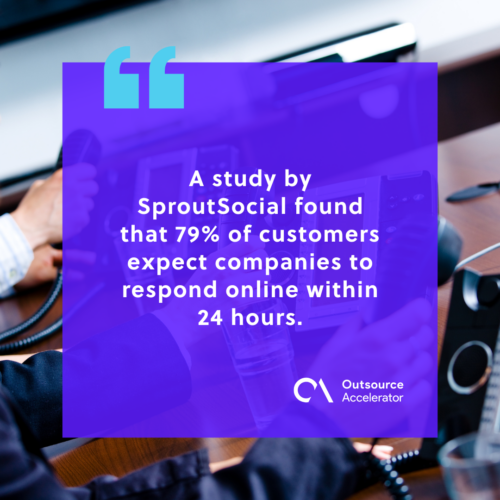
Next, one key goal is a faster response time. A study by SproutSocial found that 79% of customers expect companies to respond online within 24 hours. So speeding up your response time deserves a spot in your goals.
3. Reduce cost per contact
At the same time, watch your cost per contact (CPC). This matters most if support costs more than customers pay you. There are simple ways to reduce it. For example, you can offer callbacks during call surges and add self-service options.
By cutting CPC and meeting expectations, you raise your service standards. As a result, you drive more customer satisfaction. Over time, these efforts build long-lasting, loyal relationships.
4. Receive more positive feedback
Great service shows up in the feedback you get. The more clients promote your brand, the faster you can grow your customer base. So aim for more positive feedback and a better net promoter score (NPS). This gives social proof and turns customers into advocates.
5. Modify channel-specific metrics
Your goals should also cover the channels you use to reach clients. For example, start by expanding into social media or other channels that fit your strategy. You can also make better use of your Facebook page and chats.
Agent satisfaction
Next, consider these goals to lift your team’s happiness.
6. Balance human and automated interactions
Now is the time to boost agent productivity and satisfaction. A surge of issues can overwhelm a team. Still, chatbots and automation alone will not solve everything. So try to balance human and automated interactions.
You can use chatbots, auto-responses, and smart workflows to ease the load. As a result, agents handle interactions well. This blend improves the customer experience and helps agents build lasting relationships.
7. Prioritize employee satisfaction
Happy employees create satisfied customers.[1] They give thoughtful service because it reflects how you care for them. So check on your team’s welfare and find ways to boost it. For example, set up one-on-one meetings to review work and offer help with challenges.
8. Invest in talent acquisition and retention
Attracting and keeping quality talent is another strong goal. So invest in talent acquisition strategies and staff. Besides in-house hiring, look at flexible options like outsourcing customer service.
The Remote Group helps you get started with building your customer service team. From sourcing skilled staff to setting up your processes, they help you deliver a positive experience. Meanwhile, plan to improve retention across all teams. For example, add wellness programs and better healthcare incentives.
9. Promote collaboration
Your team can get bored doing the same solo work all day. As a result, engagement and output drop. So make collaboration a goal. For example, plan communication games, brown bag lunches, and other activities that get people talking.
10. Upskill employees
Lastly, your employees should keep learning. Find ways to train them well and boost their skills. This matters most when you roll out new tools at work.
Customer service skills
Good customer service today needs the right skills. So equip your employees with the following.
11. Enhance their troubleshooting skills
High-effort experiences hurt loyalty. For example, repeat calls and unresolved issues can lead to customer disloyalty. Agents who struggle to fix issues fast can lose customers. So help them strengthen their troubleshooting skills. As a result, clients call less often to solve the same problem.
12. Strengthen empathy and patience
You can reduce frustration with warmth and patience. In addition, empathy[2] helps your team build trust with customers. So improve empathy through active listening, key phrases, and clear promises to fix issues. Meanwhile, help your team stay patient with upset customers.
13. Introduce channel-specific expertise
Before you start an omnichannel team, check that they have the right skills. Each channel needs its own know-how. So add channel-specific training to your goals. For example, teach the basics of social media or chatbots for support.
14. Improve product expertise
Your team must stay up to date on your products and services. So share product updates as soon as they land. Give agents enough detail for when a client wants to know more. Strong product knowledge also helps them upsell or cross-sell later.
15. Practice their leadership skills
Lastly, train your employees to be service leaders. You can offer leadership training and let them set initiatives. As a result, they take ownership of each win and issue. A skilled manager knows how to build a strategy that meets and beats client needs.
Setting SMART customer service goals
Unrealistic goals can hurt your team and your brand. Targets that are too high can wear people down. As a result, it gets harder for them to serve customers. They also raise your risk of falling short. So the best goals follow the SMART principle.
- Specific: Make the goal clear. For example, say “shorten response time from six minutes to four minutes.”
- Measurable: Use numbers to track progress and set milestones.
- Attainable: Keep the goal realistic. Think about the roadblocks your team may face.
- Relevant: Tie the goal to your company vision. Check that it is worth the effort.
- Time-bound: Set a clear deadline. Add checkpoints to create urgency.

Looking at past metrics is the best way to set current goals. It shows which goals to include and what to prioritize. In addition, look at your competitors and how they do. Learn the best practices that make their service stand out.
Finally, delegate and involve other teams in creating your goals. So let the best-equipped team align each goal with the wider organization.
Frequently asked questions
What are examples of customer service goals?
Common goals include faster response times and lower cost per contact. Others focus on more positive feedback and a higher NPS. Together, they improve both service and satisfaction.
How do you measure customer service goals?
You measure them with clear metrics. For example, track response time, CSAT, retention, and NPS. As a result, you can see real progress over time.
What makes a good customer service goal?
A good goal is SMART: specific, measurable, attainable, relevant, and time-bound. So it is realistic and easy to track.
Why are customer service goals important?
Goals give your team one clear direction. As a result, issues get solved faster, and customers stay happy. In turn, this drives growth.
Can outsourcing help you reach customer service goals?
Yes. Outsourcing gives you access to skilled agents and set processes. So you can scale support and hit your goals faster.
Key takeaways
- Customer service goals guide your team to faster, better support.
- Focus goals on metrics, agent satisfaction, and core service skills.
- Balance human agents with automation to handle demand well.
- Use the SMART framework to keep goals realistic and trackable.
- Outsourcing can help you build and scale a strong service team.
Article references:
[1] Satisfied customers. Ilias, S. and Shamsudin, M.F. (2020). Customer Satisfaction and Business Growth. Journal of Undergraduate Social Science and Technology, [online] 2(2). Available at: https://abrn.asia/ojs/index.php/JUSST/article/view/60.






 Independent





