
5 emerging cloud staffing trends this 2026

What is cloud staffing?
Cloud staffing means hiring skilled remote employees who work for you on your schedule, without the cost of setting up and running a physical office team.
- It gives you turn-key offshore teams that plug into your business and scale up or down fast.
- The provider handles hiring, facilities, and logistics, so you focus on the work itself.
- In 2026, AI tools sit beside these remote teams, which makes them faster and more capable.
Cloud staffing has moved toward the business mainstream over the past decade. Remote work was already common in many firms well before remote setups became the norm. With that shift, new cloud staffing trends keep emerging. As a result, they change how businesses work and adopt new technology.
Following the latest trends helps outsourcing firms deliver high-quality service. So it also helps them outperform rivals.
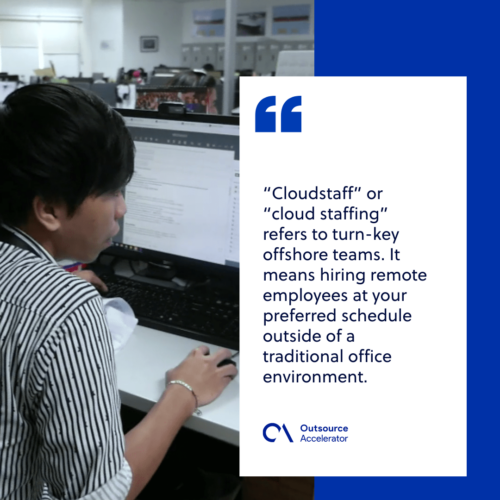
“Cloudstaff” or “cloud staffing” refers to turn-key offshore teams. It means hiring remote staff on your preferred schedule, outside a traditional office. This setup lets companies work with efficient teams without handling the logistics of building and managing one.
The term cloud staffing was first coined by Cloudstaff Modern Workforce, a company that provides world-class outsourcing solutions for small and medium-sized businesses worldwide. Cloudstaff outsourcing connects you with professional, high-quality staff who help your business grow while cutting costs. They are reliable, fast to deploy, scalable, and easy to fold into your workforce.
Top 5 cloud staffing trends this 2026
Cloud staffing has been part of modern business for a long time. Various outsourcing trends keep appearing, and they shape how providers expand and manage their services. Outsourcing is also one of the most flexible industries around. So it keeps absorbing new technology that improves operations and service. Here are the latest cloud staffing trends to watch.
Knowledge process outsourcing (KPO)
As more industries adopt advanced technology in daily work, KPO plays a bigger role in outsourcing. Knowledge process outsourcing, or KPO, deals with specialized knowledge and problem-solving. So it provides highly skilled, technical services at a low cost. For example, KPO covers financial advice, research and development, data analysis, and technical work.
Robotic process automation (RPA)
Robotic process automation uses artificial intelligence to assist businesses. It is also called intelligent automation or smart process automation. In practice, it lets anyone set up a list of steps for a software robot to run. These RPA bots then mimic human-computer actions to handle many tasks at high speed. In addition, RPA helps outsourcing firms finish repetitive tasks fast and accurately. As a result, it lifts overall productivity. In 2026, many providers also pair RPA with AI agents that handle more complex steps.
Omnichannel experience
An integrated communication strategy across channels is key to smooth service. That is what an omnichannel experience delivers. It improves customer experience by linking each step of a customer’s journey across channels. So clients can continue a chat or question from one platform to another, without starting over. This approach keeps the focus on service quality, and it meets customers on their preferred platforms. These omnichannel trends keep shaping support in 2026.
Staff upskilling
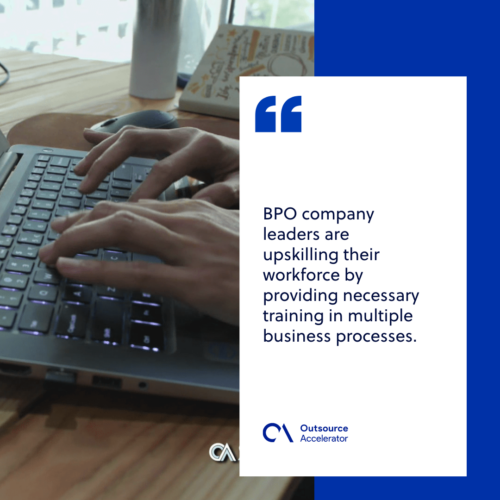
To meet client needs, the outsourcing industry must keep evolving. With that growth come cloudstaff who bring upgraded skills to the table. Because technology keeps rising, outsourcing pros need the ability to use modern tools well. Staff upskilling gives teams the knowledge to raise their service. In addition, steady upskilling and reskilling keeps staff ready for new tools. So BPO leaders train their teams across many business processes. For example, new support channels like social media open up with the right training.
Cloud computing
Cloud computing means delivering computing services over the internet instead of physical servers or storage. So it gives companies faster access to resources, better efficiency, and strong data security at a low cost. Cloud adoption has grown fast as teams rely on the internet for daily work. As cloud computing turns mainstream, investing in it benefits many providers and BPO firms. Third-party providers can also rent out their IT setup through a pay-per-use model. As a result, companies scale up without buying costly equipment.
The rise of cloud staffing in modern business
Business needs change fast, and many firms have faced staffing shortages and tight budgets. Through all of it, the outsourcing sector has stayed resilient. So it keeps helping companies that need flexible teams at short notice. Firms that once saw outsourcing as a minor tool now treat it as core. As a result, they keep searching for compatible third-party providers.
At the same time, many workers have turned to business process outsourcing (BPO) firms for new roles as cloudstaff. This trend fuels steady offshore staffing benefits for both sides. Cloud staffing is not a new idea, yet its rise is clear. The latest trends ease communication between local and remote teams. Because of this, cloud staffing has become a practical way for businesses to handle economic change. Growing AI outsourcing now pushes the model even further.
Frequently asked questions about cloud staffing
Here are quick answers to common questions about cloud staffing.
What is the difference between cloud staffing and traditional outsourcing?
Cloud staffing builds a remote team that works as an extension of your business. Traditional outsourcing often hands a whole task to a provider. So cloud staffing gives you more direct control over the people and the work.
Is cloud staffing only for large companies?
No. Small and medium-sized businesses use it the most. For many, it offers skilled staff without the cost of office space or heavy overhead.
How does AI affect cloud staffing in 2026?
AI now handles routine steps, while people guide and check the work. As a result, remote teams move faster and take on more complex tasks. Still, skilled staff remain central to quality.
Which roles are common in cloud staffing?
Common roles include customer support, data analysis, IT, and back-office work. In addition, many teams cover sales support and knowledge-based tasks.
How do I start with cloud staffing?
First, define the roles and tasks you want to offload. Next, pick a provider with a track record in your field. Finally, start small and scale once the team proves its value.






 Independent






