
Essential application development statistics shaping tomorrow’s market


In a constantly evolving digital world, creating applications that are both modern and user-friendly has become vital for business success. A seamless app experience not only enhances customer satisfaction but also drives engagement, retention, and revenue.
Take, for example, a retail brand that invests in intuitive mobile design and regular feature updates, often achieving higher conversion rates than those with outdated platforms.
Behind these strategic decisions lie crucial insights drawn from current application development statistics. These numbers reveal user behavior, platform preferences, and technology trends, helping developers and business leaders make smarter, data-driven choices.
In this article, we’ll explore the most impactful application development statistics shaping the future of the market. How can companies use them to build more relevant, high-performing apps in an ever-evolving tech world?
Let’s find out.
Application development statistics: Global market overview
The global app development industry continues to grow rapidly as businesses adapt to shifting consumer behavior and technological advancements.
Knowing these current application development statistics enables companies to make informed decisions and stay competitive in this fast-moving market:
1. The mobile app market is booming
According to Statista, the global mobile app market is projected to reach $752.57 billion by 2027, with a steady compound annual growth rate (CAGR) of 8.58% from 2022 to 2027. This growth reflects consumers’ increasing demand for innovative, high-performance applications.
Businesses of all sizes—from startups to large enterprises—are allocating more resources to develop user-centric mobile solutions that keep customers engaged.

2. Mobile app revenue continues to surge
Statista also reports that mobile apps are expected to generate over $613 billion in revenue by 2025. Mobile games lead all categories in earnings, highlighting the profitability of entertainment-focused apps and the value of investing in high-quality digital experiences.
3. Low-code development is transforming the industry
As per Fortune Business Insights, the global low-code development platform market was valued at $28.75 billion in 2024 and is projected to reach $264.40 billion by 2032.
With a remarkable compound annual growth rate (CAGR) of 32.2%, this shift enables faster and more accessible app development, especially for teams with limited coding expertise.
Application development statistics on users’ behavior
Understanding how users interact with mobile apps helps businesses create better digital experiences and avoid costly missteps. The following application development statistics reveal crucial patterns in user behavior and engagement:
4. Mobile-first access dominates user behavior
Exploding Topics revealed that 96.3% of internet users access the web through mobile phones. This trend highlights the critical role of mobile apps in reaching and retaining digital users across all sectors.
5. App usage dominates mobile internet time
According to EMARKETER, U.S. adults spend over 4 hours a day on mobile internet, with 88% of that time spent inside apps. The number continues to grow each year, underscoring the importance of prioritizing app performance and user experience.
6. Gen Z is reshaping search habits
A 2024 Statista survey found that 64% of U.S. Gen Z users use TikTok as a search engine. This trend is strongest among younger users and gradually drops in older generations, indicating a shift in how people find information online.
7. Most apps remain unused
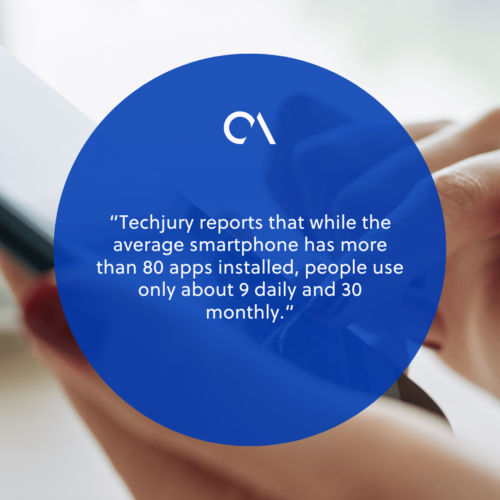
Techjury reports that while the average smartphone has more than 80 apps installed, people use only about 9 daily and 30 monthly. Around 62% of apps remain unused each month, highlighting the need to deliver genuine value to retain users.
8. Uninstall rates remain high
As per Aliotte, 28% of mobile apps are uninstalled within 30 days. This suggests that nearly one in three apps fail to meet user expectations shortly after download.
Application development statistics: Google Play vs. App Store
When developing a mobile application, choosing the right platform is a key decision. Both the Google Play Store and Apple App Store dominate the market, but each offers distinct advantages depending on your audience and monetization goals.
9. Google Play leads in global reach
The Google Play Store serves a massive international user base, with over 2.5 million active users and more than 140 billion app downloads. Its wide availability across Android devices makes it an ideal platform for reaching users in emerging markets.
10. The Apple App Store offers a strong content variety
According to Statista, the App Store hosts 2.11 million iOS apps from over 724,000 publishers. Of these, approximately 221,666 are games, while the rest cover diverse non-gaming categories.
This range provides developers with the flexibility to target diverse user interests and needs.
11. Apple outperforms in monetization
Despite having fewer available apps, the Apple App Store generates more revenue. As per Statista, in Q3 of 2022, global consumer spending reached $21.2 billion, more than double Google Play’s $10.4 billion.
The App Store is more appealing to developers focused on in-app purchases and premium content.
Achieve application development excellence with Clark Staff
Partner with Clark Staff to access skilled developers who bring your app ideas to life with precision and speed. From concept to launch, we support every step of your development journey.
Start building smarter, user-focused applications today! Get in touch with Clark Staff and move your business forward with confidence.






 Independent





