
Workforce diversity statistics in the United States for today’s leaders


What do workforce diversity statistics in the United States reveal?
Workforce diversity statistics in the United States show a labor force that keeps growing more varied in gender, race, culture, age, and belief, yet still faces wide gaps in leadership and pay.
- First, women make up a large share of entry-level talent but hold far fewer senior roles.
- Meanwhile, racial, cultural, and generational diversity keeps rising across most industries.
- Finally, younger workers now treat diversity, equity, and inclusion as a key reason to join a company.
The modern workplace keeps changing as companies adapt to new demographics. Over time, the makeup of the U.S. workforce has shifted in real ways. For example, these shifts touch gender, multigenerational teams, race, faith, and a broader view of different sexual orientations.
In addition, Remote work has opened doors for many people who once faced barriers. As a result, U.S. companies now reach a wider talent pool. Because of this, leaders think harder about how they hire and shape culture.
So in this article, we highlight the most useful workforce diversity statistics in the United States. First, we help today’s leaders read current trends. Next, we help them make choices that lift both their people and the whole organization.
What makes diversity in the workplace highly essential?
A diverse workplace shapes how companies grow and build real connections. However, modern employees want more than basic benefits. Instead, they look for cultures that value fairness and purpose. So strong diversity management helps meet those needs. As a result, staff who feel respected stay motivated.
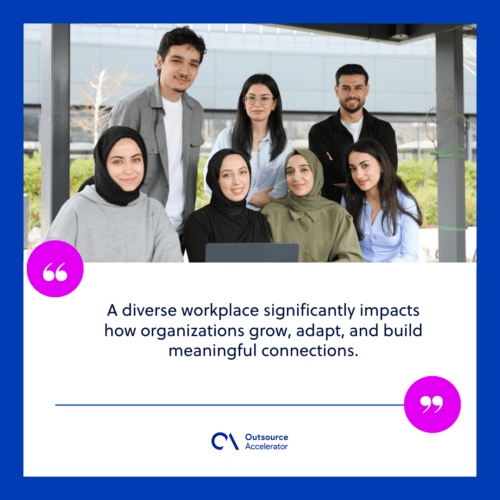
Because of this, the workforce diversity statistics below show why diversity and inclusion matter so much.
Pew Research Center finds broad support for DEI
For example, a 2023 Pew Research Center survey reports that 56% of employed U.S. adults view DEI efforts positively. However, views differ across groups. So leaders must track changing values while they handle complex public debate.
Eagle Hill Consulting links culture and performance
In addition, Eagle Hill Consulting reports that 73% of U.S. workers say culture affects how well they perform. Meanwhile, 72% believe culture shapes their productivity. Notably, 65% credit culture for good service, while 64% link it to innovation. Because of this, strong values matter, such as respect (74%), integrity (57%), and well-being (51%).
Younger workers prioritize DEI
Furthermore, research from SelectSoftware Reviews shows that 77% of Gen Z employees and 63% of millennials treat DEI as a big factor when they choose a job. As a result, these expectations push companies to welcome diverse views.
Gartner links diversity to financial outcomes
Similarly, a Gartner study found that 75% of companies with diverse frontline teams beat their financial goals. So varied views often lead to stronger plans. In turn, teams build more resilient results.
Glassdoor highlights continued interest in DEI programs
Meanwhile, Glassdoor reports that access to DEI initiatives grew across corporate America in 2020 and 2021, though progress slowed after that. Still, most reviewers view these programs well. For example, the Northeast and West Coast lead the way.
REI’s internal challenges show the value of real action
By contrast, reports on REI show that public promises do not fix internal issues on their own. In fact, workers note that the retailer scaled back its REDI strategy. As a result, inconsistent effort can erode trust. In short, a real commitment to diversity aligns a company with what today’s workforce expects.
Vital workforce diversity statistics in the United States
Now, let us look closer at what the key workforce diversity statistics in the United States say across several areas.
Gender workforce diversity statistics in the United States
First, gender balance keeps shifting. Still, wide gaps remain in promotion and leadership.
- FT analysis shows unequal leadership pathways. For example, an FT review of U.K. and U.S. listed firms finds that CEOs usually rise through male-dominated finance and operations roles. On the other hand, HR, marketing, and PR are the only C-suite areas where women hold the lead.
- World Economic Forum highlights leadership gaps. Meanwhile, the World Economic Forum reports that women made up 41.9% of the global workforce in 2023, yet held just 32.2% of senior roles. In fact, women filled about 25% of C-suite roles, even though they made up 46% of entry-level talent.
- McKinsey shows promotion gaps. In addition, McKinsey’s Women in the Workplace 2023 reveals that for every 100 men promoted to manager, only 87 women moved up. Notably, the gap widens for women of color, at just 73 per 100 men.
So these numbers show clear challenges. Because of this, leaders must act to build balanced teams.
Racial workforce diversity statistics in the United States
Next, racial diversity keeps shaping the workforce. As a result, it affects how firms hire and open paths to growth.
- Bloomberg and the Legal Defense Fund highlight pipeline risks. For example, Bloomberg reports that changes to affirmative action may affect talent pipelines. Meanwhile, the Legal Defense Fund adds that 82 major companies backed affirmative action in amicus briefs.
- The U.S. Bureau of Labor Statistics shows current levels. In addition, the U.S. BLS notes that White Americans make up 76.5% of today’s workforce. Meanwhile, Black or African American workers make up 12.8%, Asian workers 6.9%, and Hispanic or Latino workers 18.8%.
- Pew Research reveals racial gaps in workplace experience. Notably, Pew Research finds that over 50% of Black workers feel their race limits success at work. By contrast, that figure is 41% for Asian workers, 23% for Hispanic workers, and 18% for White workers.
So these numbers point to gaps that persist. Because of this, leaders must build fair spaces for everyone.
Religious workforce diversity statistics in the United States
Faith also plays a big role in how staff see themselves. In turn, it shapes workplace culture.
- Pew Research Center highlights America’s religious makeup. For example, the 2023 to 2024 Religious Landscape Study reports that 62% of U.S. adults identify as Christian. Notably, Pew says this share has held fairly steady since 2019.
- Pew Research reveals different views on discrimination. Meanwhile, Pew finds that Americans see varying levels of discrimination across groups. For instance, 44% say Muslims face a great deal of discrimination, while 40% say the same for Jews.
So these numbers show the value of understanding diverse beliefs.
Cultural workforce diversity statistics in the United States
In addition, Cultural diversity shapes the character of the workforce. In turn, it affects how staff work together.
- The U.S. Bureau of Labor Statistics shows the foreign-born workforce. For example, the U.S. BLS reports that Hispanic or Latino workers made up 48.7% of the foreign-born labor force in 2024, while Asian workers made up 24.6%.
- Statista highlights pay gaps among foreign-born workers. Meanwhile, Statista notes that foreign-born full-time workers earned a median of $987 per week in 2023, while native-born workers earned $1,140.
So this pay gap points to real economic strain for immigrant staff.
Age and generation workforce diversity statistics in the United States
These workforce diversity statistics also connect to how each cohort works. For example, they link to the Gen Z work ethic and the millennial work ethic.
- U.S. Labor Force data shows rising education. For instance, the share of workers without a high school diploma dropped from about 9% among Baby Boomers to 6.7% among Millennials. Meanwhile, the share with only a high school diploma also fell from 30.1% to 25.8%.
- Deloitte shows growing interest in degrees. In addition, Deloitte notes that the share with a bachelor’s degree or higher rose from about 34.4% for Baby Boomers to 43.6% for Millennials. Notably, Deloitte adds that 32.8% of elder Gen Z workers hold a bachelor’s degree.
Political workforce diversity statistics in the United States
Political views also shape how Americans read work policies. As a result, political diversity is now part of daily workplace dynamics.
- Gallup highlights a near-even split. For example, Gallup’s 2024 data shows that 49% of U.S. adults lean Democratic, while 48% lean Republican.
- Pew Research reveals concern about social media power. Meanwhile, Pew Research finds that 78% of Americans believe social media firms hold too much political power, up from 72% in 2020.
The future of workforce diversity in the United States
So the future of workforce diversity will build on the numbers above. As a result, it will push firms to rethink how they support people.
Expanding multigenerational teams
First, the workforce will span a wider age range than ever. For example, people work longer, while younger cohorts arrive with new priorities. So firms must balance communication styles and career hopes. In turn, that helps every age group play to its strengths.
Increasing racial and ethnic representation
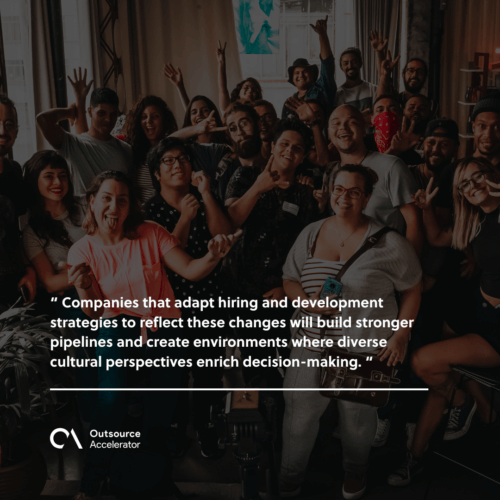
Meanwhile, growth among Hispanic, Asian, and multiracial communities will shape future trends. So firms that adjust hiring to match will build stronger pipelines. As a result, diverse views will enrich decision-making.
Evolving gender and leadership dynamics
In addition, more women and gender-diverse professionals will pursue leadership paths. So firms that support fair advancement will build balanced executive teams. In turn, modern leadership practices will bring broader views into planning.
Greater focus on inclusion for remote and hybrid workers
As flexible work grows, leaders must keep people connected across digital spaces. So clear communication will help distributed teams thrive.
Growing conversations around political and social identity
Finally, employees will keep bringing their values to work. As a result, they will shape talks about policy and culture. So leaders who handle these talks with respect will help teams manage differences well.
Workforce diversity statistics in the United States: FAQs answered
This section answers common questions about workforce diversity statistics in the United States.
What do current diversity statistics reveal?
In short, recent statistics show growing representation across gender, race, culture, and generations. So the workforce is shifting fast. Because of this, leaders must read changing identities to build lasting strength.
Why do diversity statistics matter to employers?
They reveal gaps in opportunity, leadership access, and daily experience. As a result, employers use these insights to refine policy. In turn, that helps them attract talent and support fair growth.
How do employees benefit from diverse workplaces?
For example, employees gain broader views, stronger teamwork, and more innovation. In addition, diversity builds trust and sharpens problem-solving. So people feel valued, which lifts engagement.
How often do companies update diversity data?
Many firms review their numbers each year. Still, some track progress more often. As a result, regular updates help leaders watch trends and test new programs.
How will future statistics shape workplace strategies?
Future data will guide hiring, leadership growth, and flexible-work choices. So as demographics change, employers will read new needs. In turn, they can build belonging across every setting.
Key takeaways
- First, the U.S. workforce keeps growing more diverse in gender, race, culture, age, and belief.
- However, women and workers of color still face clear gaps in promotion and leadership.
- In addition, younger workers treat DEI as a key reason to join and stay at a company.
- Because culture drives performance, strong values lift both productivity and trust.
- Finally, leaders who track these statistics can build fair, inclusive teams that perform.






 Independent





