
Insight into recruitment and management of Filipino talent

How do you recruit and manage Filipino talent?
To recruit and manage Filipino talent well, you partner with a BPO provider that hires staff under its local entity, you source candidates through social media and referrals as much as job boards, and you lead the team with clear communication and respect for local culture.
- A BPO partner handles hiring, payroll, HR, and legal work, so you do not need to set up a company in the Philippines.
- The best candidates often come through referrals and social media, not just job portals.
- Good management rests on clear briefs, regular feedback, and respect for Filipino work culture.
Running an offshore team in the Philippines can be a great move. Still, it pays to prepare before you engage a provider. This guide walks through how the model works, where to find people, and how to keep them.
The BPO industry
The BPO industry keeps growing, and it is no longer just for large firms. Small and medium businesses now set up non-core functions in the Philippines and get strong results. Almost any role can be filled this way.
Popular roles include admin support, accounting, data entry, developers, digital marketing, and both inbound and outbound call center work. For context on the sector itself, see this overview of the Philippine BPO industry and where it is headed.
What does your traditional BPO do?
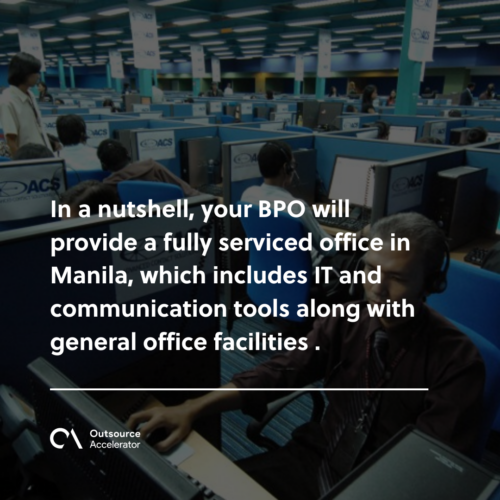
In short, your BPO gives you a fully serviced office in a city like Manila. That includes IT, communication tools, and general office facilities. The provider also recruits, hires, and onboards your team.
It handles all the HR, payroll, and legal work too. Your staff are hired under the provider’s local entity, so you do not need to set up a corporation in the Philippines. This is the core of the staff leasing model, where the team still works as an extension of your own.
Some providers do hourly or project work. Others offer training and full management, or full-time permanent roles that act as part of your team.
Standard operating procedures and fees
As a rule, the client covers all employee-related costs. On top of that, the BPO charges a monthly service or management fee per head. Extra training or special requests usually cost more.
In some cases the setup can be split to fit your needs. For example, seat leasing means you house your own staff in the BPO office but pay them directly. Staff leasing means your staff sit under the BPO contract and payroll. Agree on all of this before you sign.
Here is how the main terms tend to work:
- Process: the provider sources, screens, and interviews candidates, then sends the strongest ones for your own interview before a job offer.
- Fees: recruitment fees often run at 10% to 20% of the gross annual compensation. The percentage looks high, but the salary base is much lower.
- Replacement guarantees: you can usually expect a one-month to six-month guarantee if a hire does not work out.
- Talent pool: demand for skilled, lower-cost workers has lifted the market. The Philippines is known as a call center capital, helped by strong English, a soft accent, and many degree-qualified candidates.
- Challenges: rare or very location-specific skills can slow a search or raise the cost. Treat those skills as a bonus, not a must-have. Keeping roles at mid level helps you find people faster and spend less.
Sourcing of talent
Social media and events
Social media is a great way to find Filipino talent. Nearly everyone is on Facebook and active in industry groups. So if you are not using an agency, start there when you launch a campaign.
The Philippines is a very social community. There are often industry events, especially for technical roles. As a result, getting to business or tech meetups helps you meet people and build a network.
Job portals
There are many job portals in the Philippines. They tend to generate lots of applicants, though many are not qualified. So if you use one, make sure someone can screen the volume, because it takes time. Common portals include:
- Jobstreet
- JobsDB
- Kalibrr
In practice, many of the best hires still come through headhunting and referrals. For a fuller playbook, see this guide to offshore staffing in the Philippines.
Mandatory benefits and talent management
The 13th-month pay is a required benefit. It is usually one extra month of pay, given in December, and can be pro-rated. Vacation leave starts low by law, so most employers offer more. As a guide, aim for at least 12 vacation days and 5 sick days.
Run regular performance reviews, since feedback keeps everyone on track. When you pick a provider, make sure the HR team supports you here. They can also help build individual performance plans.
Probation can run up to six months, which is longer than in some countries. Because of this, you get enough time to confirm a good fit before the hire is regularized. Annual reviews then let you tie any pay rise to performance.
Health insurance is a strong retention tool. For more ideas, see these fixes for common employee retention problems.
Differences in culture and managing people in the Philippines
The Philippines is a warm, friendly country. People love to sing and dance, so do not be surprised by an invite to karaoke when you visit. A few cultural points make managing Filipino talent easier. To go deeper, read this look at Filipino work culture.
1. Plan around public holidays
There are many public holidays in the Philippines, which can disrupt schedules. So agree on holiday rules early, and decide whether you will pay overtime or give the days off. This yearly list of holidays in the Philippines helps you plan ahead.
2. Choose an accessible office location
Think hard about where the office sits. Is public transport easy to reach? A short distance can still mean a two-hour trip each way. Popular districts include Ortigas, Makati, BGC, and Quezon City. Each has trade-offs on cost, transport, and nearby food options.
3. Respect “hiya” and give feedback privately
Filipinos are very respectful toward seniors and managers, so expect to be called “Sir” or “Ma’am.” The culture is also gentle about criticism. Do not scold anyone in public, because this causes “hiya,” a strong sense of shame in front of peers. If you need to correct a mistake, do it privately, cover the steps to fix it, and end on a positive note.
4. Encourage ideas and praise good work
Encourage your team to share ideas. Give them the tools to own their role and ask what they think. Including them in brainstorming builds confidence. On top of that, praising hard work makes people feel valued.
5. Communicate clearly and confirm understanding
Be clear and specific about what you need. English is not everyone’s first language, so things can be misread. People may also say “yes” to be polite without fully understanding. So ask them to repeat the task in their own words. Following up by email with bullet points is a simple way to confirm.
6. Factor in family commitments
Family matters a great deal in the Philippines. Many staff are the main earner for parents and siblings. So bear this in mind before asking for weekend or overtime work. Offering health benefits for dependents is a great way to earn family buy-in.
7. Expect paperwork and processing time
Government processes can be slow and paper-heavy, whether for a visa or a business permit. Expect this to test your patience, because things simply take time. A good provider absorbs much of this for you.
Why it works
The model works because it is simple and saves money. It cuts labor and recruitment costs and takes time-consuming tasks off your plate. As a result, you can grow while keeping quality high.
A good provider also takes on the legal responsibility. So it is a great way to test the water before you grow large enough to open your own entity. You still stay in control of your staff and treat them as part of your team.
5 things to remember
1. Visit your team
Once your team is onboard, visit if you can. Offer some training and get to know them. This builds trust fast and shows you have hired capable people.
2. Do not run before you can walk
Think about your time, how many people you want, and who will manage them. If you are building across several functions, start with the core area first. Spreading too thin early on hurts your results.
3. Keep roles clearly defined
Try not to merge two roles into one. A front-end developer rarely wants to do admin work. Keep roles focused, just as you would at home. Filipino staff often prefer clear specialization.
4. Allow time to find talent
Factor in notice periods and screening time. You do not need 15 candidates for one role. Instead, ask your provider for a short list of pre-interviewed people. Allow around six weeks to onboard someone, since notice can run 30 days.
5. Keep rare skills in-house
If a skill is rare and costly at home, it will be hard to find here too. So keep those skills in your internal team. Use offshore staff to take routine tasks off your team, which frees you to focus on growth.
Personal advice
Pick a responsive recruitment partner. If you have to chase for a proposal or feedback, they are not the right fit. Try not to use too many agencies at once, because it causes confusion and disputes over candidates. Ask for salary estimates up front and treat the recruiter as your consultant.
If you are building a small team, name one person as team leader and point of contact. Be ready to pay a little more for that key hire, since it saves you time later. Flexible hours also help, as they let staff avoid the worst of Manila traffic.
Make sure someone manages the team day to day. Open easy lines of communication through tools like Slack or video calls. Prepare your onboarding and orientation, and introduce new hires to the wider team. Your provider can share onboarding documents and help set a training schedule.
Finally, train and invest in your people, just as you would at home. As the saying goes: “CFO: What happens if we train them and they leave? CEO: What happens if we don’t and they stay?” Investment is a retention strategy in itself.
Frequently asked questions about recruiting and managing Filipino talent
Do I need to set up a company in the Philippines to hire Filipino staff?
No. A BPO or staff leasing provider hires the team under its own local entity. So you get the staff and the compliance without registering a company yourself.
How long does it take to hire Filipino talent?
Plan for around six weeks from brief to start date. Sourcing and screening take time, and many candidates have a 30-day notice period to serve first.
What benefits are mandatory for Filipino employees?
The 13th-month pay is required, along with social security, health, and housing contributions. Most employers add paid leave and private health cover to stay competitive and keep good staff.
What is the best way to manage a team in the Philippines?
Lead with clear briefs, regular feedback, and respect for local culture. Give praise in public and correct mistakes in private. Confirming instructions in writing also prevents misunderstandings.
Which roles work best for offshore Filipino teams?
Admin support, accounting, data entry, customer service, digital marketing, and development all work well. Mid-level, clearly defined roles are easiest to fill and most cost-effective.






 Independent






