Afni is a privately held customer engagement and business process outsourcing provider based in Bloomington, Illinois, running contact centre, collections and insurance operations from the United States, the Philippines and Mexico. Its own account of its history says the story began in 1936 in Bloomington, offering account support to local businesses, which makes it one of the oldest names in North American receivables and customer care outsourcing.
Services & Capabilities
Afni sells five solution lines, presented on its site as stages of the customer lifecycle plus a commercial model. Each is a recognisable outsourcing category; the specialist content sits mainly in collections and insurance.
- Acquisition and growth: inbound sales, chat-based selling and upsell programmes, in which agents are trained to identify customer wants and recommend products.
- Care and retention: omnichannel customer service, reaching customers through voice, chat, messaging, email or social media, with retention work layered on top of inbound care.
- Collections: first- and third-party recovery work. Its collections page describes 87 years of excelling at collecting past-due balances, and says Afni abides by the Fair Debt Collection Practices Act and the Telephone Consumer Protection Act (TCPA) and is an active member of the Association of Credit and Collection Professionals (ACA).
- Property and casualty insurance: a line that runs from licensed sales and unlicensed policy and claim support to full subrogation management, plus premium collections.
- Gainshare model: a pricing option rather than a service, described below.
Specialist versus commodity: Inbound care and sales are the most contested part of the market, where Afni competes with many larger contact centre providers. Collections and subrogation are different. They require licensed staff, state-by-state compliance and negotiation skill, and the company points to a long-time membership of the National Association of Subrogation Professionals (NASP) and to using RegEd to manage compliance with state licensing requirements. Those credentials raise the cost of switching away from Afni for insurers and lenders, and they are where its long history carries most weight.
Gainshare pricing: Afni offers a model in which, when it helps a client achieve its goals, it shares in the financial upside. Its own worked examples show how it is meant to work in insurance and care: average cycle time from FNOL to settlement reduces from 15 to 10 days through automation and analytics, faster settlements save $500k a year, and Afni earns 20% of realized savings. In another example Afni receives 5% of increased revenue, paid monthly, and in a third it receives 25% of a $1M a year labour cost reduction. These are illustrations, not reported results, but they show a firm prepared to tie part of its fee to outcomes rather than to hours, a model that suits recovery work where results are measurable in money.
Industry framing: The company describes a CAREfirst philosophy for protecting a client's brand equity while collecting or selling, a positioning aimed at clients who worry that aggressive recovery damages the customer relationship.
Client Base & Market Position
No named client organisations were found on the company's website or in its news releases during research, so the client picture comes from the industries the firm describes and from secondary sources.
Industries: Afni's industry page lists four sectors: communications, insurance, healthcare and financial services. For communications clients it says it consistently achieves exceptional net promoter scores; in healthcare it serves hospitals, clinics, medical groups and insurance companies with contact centre and back-office support; in financial services it offers payment management and negotiation. Outsource Accelerator's directory lists a wider clientele across banking, insurance, e-commerce, tech, logistics and energy. The platform record's verticals are Automotive; Financial Services & Banking; Technology & SaaS.
Insurance as the anchor vertical: Insurance recurs across every part of the business: a dedicated P&C solution, subrogation management, NASP membership, a director of insurance platforms on the leadership roster, and the October 2026 Tucson hiring drive for insurance professionals. Read together, these point to insurance carriers as the client group where Afni has the deepest process knowledge and the longest relationships, which also creates concentration in a sector that is consolidating and automating claims work.
Regulatory exposure: In February 2026 Law360 reported that Afni faces a class action over alleged misleading claim letters. For a firm whose pitch to insurers and lenders rests on compliance, litigation over its correspondence is a reputational risk that buyers will ask about in due diligence, whatever the outcome of the case.
Competitive set: The platform's talent movements map Afni's competitors closely. Over 24 months it recorded 13 senior arrivals, most often from VXI, Teleperformance Global Services and ResultsCX, and also from Everise, Concentrix and Accenture. These are the large CX outsourcers Afni meets in customer care bids, particularly for Philippine delivery. In collections and subrogation its competitors are narrower specialists, where its licensing and association memberships matter more than scale.
Market position: Afni sits between the global CX majors and the small regional collection agencies. It has more people than most specialist recovery firms and more regulated-process depth than many general contact centre providers, but no client counts, analyst rankings or named reference accounts were found during research, which makes it harder for a buyer to benchmark it against peers that publish them.
Delivery Infrastructure & Operations
Afni runs a three-country delivery model: a US base for headquarters, licensed and compliance-sensitive work, a large Philippine operation for scale, and a nearshore site in Mexico. Its locations page says it offers multiple service delivery configuration options, including brick and mortar, hub and spoke, fully remote and blended models.
United States: The company's US sites are in Bloomington, Illinois, its headquarters, and Tucson, Arizona. In October 2026 Afni launched a Tucson hiring initiative for approximately 200 insurance professionals, among them 60 licensed insurance sales agents, with an on-site hiring event on October 22 for front-line positions. Jamie Thomas, Senior Vice President of Operations, is a Tucson resident and fronted the announcement. Licensed insurance sales must be done by US-licensed staff, so Tucson is where Afni's insurance growth is staffed.
Afni@Home: A remote programme provides what the company calls secure, scalable virtual support across the globe, with US remote staff in several states. Afni has since expanded its remote hiring opportunities to Iowa and Wisconsin. Remote hiring lets the firm add licensed and US-based agents without opening new buildings, at the cost of supervising a dispersed workforce in regulated processes.
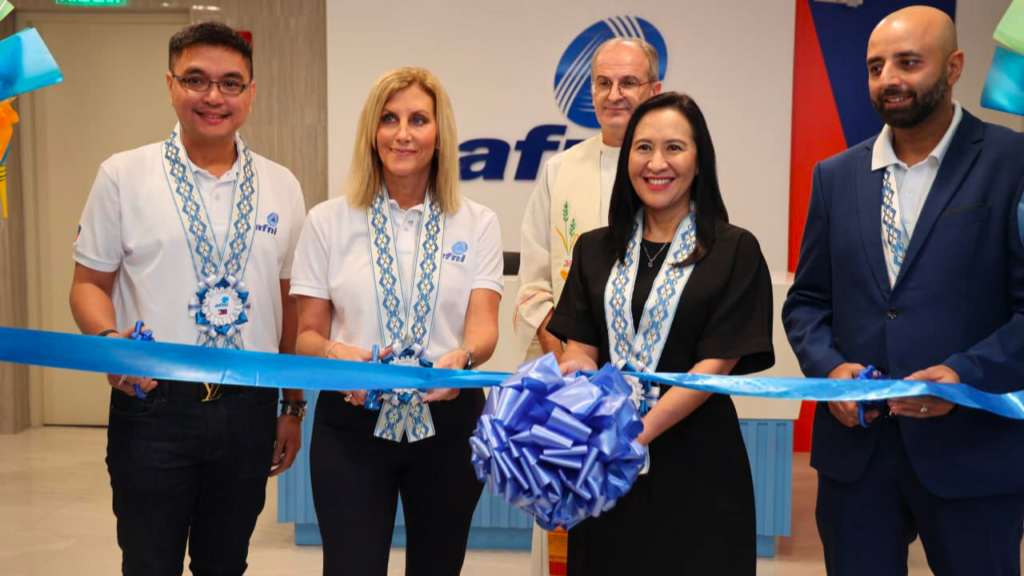
Philippines: Afni established its Philippine presence in 2012. It added a site in Fairview in 2020, and a third, in Santa Rosa, Laguna, in 2024. The expanded SMT4 site in Quezon City covers over 100,000 square feet across five floors and houses more than 4,000 employees, and Quezon City Mayor Joy Belmonte joined Afni executives at its ribbon-cutting. Santa Rosa is the third office in the Philippines and the first outside Metro Manila, and Afni targeted at least 3,000 new employees there by year end. With more than 8,000 staff in the country, the Philippines is now the operational centre of the business.
Mexico: A Monterrey office gives US clients a nearshore, Spanish-capable option in a similar time zone. Michelle Eickmeyer is Vice President of Operations and General Manager of Mexico Operations.
Hiring signals: The platform records 30 active job postings at Afni. A current opening for a Virtual Project Coach in insurance sales, posted in the United States in September 2026, fits the Tucson insurance build-out and the remote model.
Certifications: No information security or quality certifications were found on the company's website during research, an evidence gap that buyers placing payment and claims data with an outsourcer will want closed in due diligence.
Ownership, Financials & Scale
Ownership: Afni is privately held. Its leadership page records that Ron Greene joined as Corporate Controller in 1992 and that in 1995 he partnered with Bruce Griffin to purchase the company. No later change of ownership was found during research. A management-led ownership structure of this kind gives the firm continuity of strategy and leadership, and avoids the fixed holding period of a private equity owner, but it also means that expansion such as the Philippine sites has been funded from the business itself rather than from sponsor capital.
Financials: No company-published revenue figure was found during research.
Scale over time: The company's history traces growth from a small collections agency with 50 employees. Outsource Accelerator's directory later cited a team of around 6000, earlier records put the workforce at 7,800, and the company's Santa Rosa release described over 10,000 employees across the Philippines, the U.S. and Mexico. The Santa Rosa target of at least 3,000 new employees by year end, and the 2026 Tucson drive for approximately 200 insurance professionals, show that expansion has continued in both offshore and onshore capacity.
Mix of growth: Most of that growth has been offshore. More than 8,000 employees are in the Philippines, and the expanded Quezon City SMT4 site alone houses more than 4,000. That shift changes the firm's cost base and its currency exposure, since clients that are mainly in the US are now served largely from the Philippines.
Commercial model: The gainshare model links part of Afni's revenue to client outcomes, with worked examples in which it earns 20% of realized savings or 5% of increased revenue. Outcome pricing can raise returns on recovery and insurance work where Afni performs well, but it also makes revenue less predictable than headcount-based billing.
Financial leadership: Joe Glawe joined Afni in 2018 as Chief Financial Officer. He is a CPA with over 40 years of experience at CliftonLarsenAllen LLP, an accounting background typical of a privately owned firm that reports to its owners rather than to public markets.
People, Leadership & Culture
Leadership: Ron Greene is President and CEO. He joined Afni as Corporate Controller in 1992 and partnered with Bruce Griffin in 1995 to purchase the company, and his leadership page credits him with growing it from a small collections agency into a global customer engagement provider. A CEO who is also an owner, with more than three decades at the firm, shapes a culture of continuity and internal promotion.
Senior team: The executive team is long-tenured and mostly home-grown.
- Kathy Poley, Chief Operating Officer: over 30 years of industry experience; she joined Afni in 2004 as a Center Director and progressed to Vice President of Client Services before becoming COO.
- Mike Schwermin, Chief Information Officer: joined in 1998 as a Network Engineer and became Director of IT in 2012.
- Joe Glawe, Chief Financial Officer: joined in 2018 after a career as a CPA.
- Rex Schaeffer, Chief Compliance Officer: over 30 years of experience in legal and leadership positions, including two decades in leadership roles at State Farm, an insurance background that matches the firm's insurance focus.
- Khalid Khursheed, Country Manager for the Philippines: joined in 2012 and is credited with Afni's growth, especially in the Philippines.
- Jamie Thomas, Senior Vice President of Operations: joined in 1998 as Workforce Manager.
- Wendy Kempf, Vice President of Client Services: joined in 1999.
Amy Peyres, who leads business planning and customer insights, has over 25 years of financial and operational analysis experience, including 16 years at Afni. The pattern is clear: several of the most senior leaders have spent twenty years or more at the company. That depth of institutional knowledge is an asset in regulated recovery work, but it also concentrates succession risk in a small group of long-serving executives.
New capability hires: Recent appointments add skills the firm's history did not need. Mark Hinayan, Vice President of Philippine Operations, joined in 2024, and Kiran Devkar, Vice President of AI and Software Engineering, leads AI and software strategy development.
Talent movement: Over 24 months the platform recorded 13 senior arrivals, from VXI, Teleperformance Global Services, ResultsCX, Everise, Concentrix and Accenture, and 2 senior departures, to Acquire Intelligence and VXI. Far more senior people joined than left, and the arrivals came mainly from larger CX outsourcers, which indicates Afni is hiring experienced operators to run its expanding Philippine capacity.
Culture: Heidi Epley oversees all HR departments across three geographical regions. The firm runs an AfniCARES programme that supports charities including St. Jude Children's Research Hospital, and an annual ACE Awards programme for its Philippine staff.
Technology & Innovation
Afni's technology offer is built around automation inside its own operations rather than a licensed product. Its recent news shows a deliberate effort to build credentials in robotic process automation and AI agents.
Agentic automation: Afni says it is gaining national recognition for agentic automation and AI innovation. Its Lead RPA Developer, Kaushik Srinivasapuram, took first place for individual contribution in the Hackathon for Business Transformation at the Microsoft Power Platform Conference 2025. He built an AI-powered Insurance Claim Processing Agent within Afni's environment, using Microsoft Copilot capabilities including zero-shot prompting and computer use. The choice of use case matters: claims processing is the insurance work that sits at the centre of Afni's P&C line, so the firm is automating its own core process rather than experimenting at the edges.
UiPath relationship: Afni was invited to join the UiPath Product Advisory Council and says it will contribute insights that influence UiPath's product roadmap, strategy and innovation priorities. A seat on a vendor advisory council gives Afni early sight of automation tooling and signals that it runs UiPath at enough scale to be useful to the vendor.
Leadership for technology: Kiran Devkar, Vice President of AI and Software Engineering, leads AI and software strategy development, and Mike Schwermin, Chief Information Officer, has been with the firm since 1998. The combination of a long-serving CIO and a dedicated AI and software leader shows a firm separating infrastructure from new product and automation work.
Automation and the gainshare model: Afni's gainshare examples describe cycle time from FNOL to settlement falling from 15 to 10 days through automation and analytics. Outcome pricing gives the firm a commercial reason to automate: under hourly billing, automation reduces revenue, while under gainshare it can increase it. That alignment is the most coherent part of its technology story.
Channels: Its care and retention service reaches customers through voice, chat, messaging, email or social media, a standard omnichannel set.
Limits: No proprietary platform, patents or named analytics product were found during research, and Afni's automation work is described through awards and vendor relationships rather than client results. For buyers, the evidence of capability is real but early, and they would need to see measured outcomes on their own processes.
Strategic Assessment
Strengths
- Regulated recovery heritage: A history that began in 1936, collections compliance under the FDCPA and TCPA, ACA membership and long-time NASP membership give Afni credibility in collections and subrogation, where specialist knowledge raises switching costs.
- Insurance depth: A P&C line from licensed sales to full subrogation, a Chief Compliance Officer with two decades at State Farm and a 2026 Tucson hiring drive for insurance professionals make insurance its clearest specialism.
- Scale in the Philippines: More than 8,000 Philippine employees across Quezon City and Santa Rosa give it offshore capacity well beyond most specialist recovery firms.
- Stable ownership and leadership: A management-led ownership dating to the 1995 purchase and a long-tenured executive team provide continuity for multi-year client relationships.
Risks and Vulnerabilities
- Litigation over claim letters: The class action reported in February 2026 strikes at the compliance reputation on which its insurance and collections pitch rests.
- Offshore concentration: Most of the workforce now sits in the Philippines, exposing the firm to peso movements and to competition for Philippine talent with VXI, Teleperformance and Concentrix.
- Limited public evidence: No named clients, analyst rankings, security certifications or published revenue were found, which makes it harder for buyers to compare Afni with peers that disclose them.
- Succession: Several senior leaders, including the CEO-owner, have been at the firm for decades, concentrating knowledge in a small group.
Opportunities
- Outcome-based pricing: The gainshare model lets Afni turn automation gains in claims and collections into revenue rather than lost hours.
- Automation credentials: The UiPath advisory council seat and the claims-processing agent built on Microsoft Copilot give it a base for automating its own insurance and recovery processes.
- Onshore and nearshore growth: Afni@Home expansion into new states, the Tucson insurance drive and the Monterrey site let it meet clients that need US-licensed or nearshore staff alongside Philippine scale.