Services & Capabilities
Cogent's catalogue is built around contact handling, with e-commerce operations, digital marketing and CX consultancy layered on top. The platform record lists its service lines as AI & Automation Services, inbound voice and outbound voice.
- Contact centre: The core line covers handling customer complaints and inquiries, customer lifecycle management, business analytics, partner support and upselling. The firm also offers after-sales support, revenue management and order processing. Partner support for marketplace sellers and lifecycle work are the higher-value parts of this list, because they tie the provider to a client's commercial outcomes rather than only to its contact volumes.
- CXM and omnichannel: The CXM page describes omnichannel capability across chat, e-mail, advanced interactive voice response, voice and AI-based chatbots, plus a Social Media Response Management Service for customer interactions on social channels. These are sold as one proposition rather than as separate modules, which suits clients that want a single owner for every customer channel.
- CX consultancy: Cogent offers consultancy to evaluate and tailor CX strategies and solutions, aimed at improvements in cost, revenue and customer satisfaction. This is the least commodity-like item in the portfolio and a route into advisory work with existing accounts.
- E-commerce operations: The e-commerce line covers analytics, conversion rate optimisation, catalogue management, logistics management, loyalty programmes, and return and refund management. The returns service coordinates customers, logistics partners and sellers so that returns and refunds are processed within agreed service level agreements, a commitment specific enough to contract against.
- Digital marketing: A transformative-services line bundles search engine optimisation, social media marketing, content marketing, email marketing, digital strategy and analysis, and online reputation management, including review management and social listening.
Specialist versus commodity: Inbound and outbound voice in Indian languages is the volume base, and it is where pricing pressure is sharpest. The e-commerce and returns work sits close to fulfilment and deepens an account beyond the contact centre, which raises switching costs for the client. The marketing stack is a bid for a larger share of a client's customer-facing spend, but it puts Cogent against specialist agencies on work where its cost advantage is thinner.
Delivery evidence: The case-study page lists six engagements: customer feedback channels across several technology platforms, self-service to absorb seasonal volume spikes, real-time automation of large data inflows, non-delivery returns, location mapping and a smart IVR. None names the client and none reports a measured outcome. The cases are useful evidence of capability but weak proof: a buyer cannot test whether the same work applies at its own volumes without direct references.
Client Base & Market Position
Vertical mix: Cogent says its clients are diversified across more than 10 industry verticals, naming banking and financial services and e-commerce as its high-growth sectors. The published case work adds an automotive manufacturer that had difficulty providing service during vehicle breakdowns, which shows the firm handling field-service coordination as well as retail and financial contact work.
Client evidence: No named client was found on the company's site or in the other readable sources reviewed. The case studies refer only to unnamed clients, for example clients that struggled to manage a rise in customer interactions within a limited time span. For a domestic CXM operator of this scale, referenceable logos and outcome metrics would be the normal proof points. Without them the commercial claims cannot be tested before contracting, and client references become the first diligence request.
Competitive position: Cogent competes for Indian domestic CXM contracts against the India delivery arms of multinational CX providers and against domestic peers. Its pitch is language coverage and India-specific process knowledge, not price against offshore delivery. Banking and e-commerce, the two sectors it names, are also the sectors where Indian consumers expect service in their own language, which aligns the vertical focus with the firm's main operational claim.
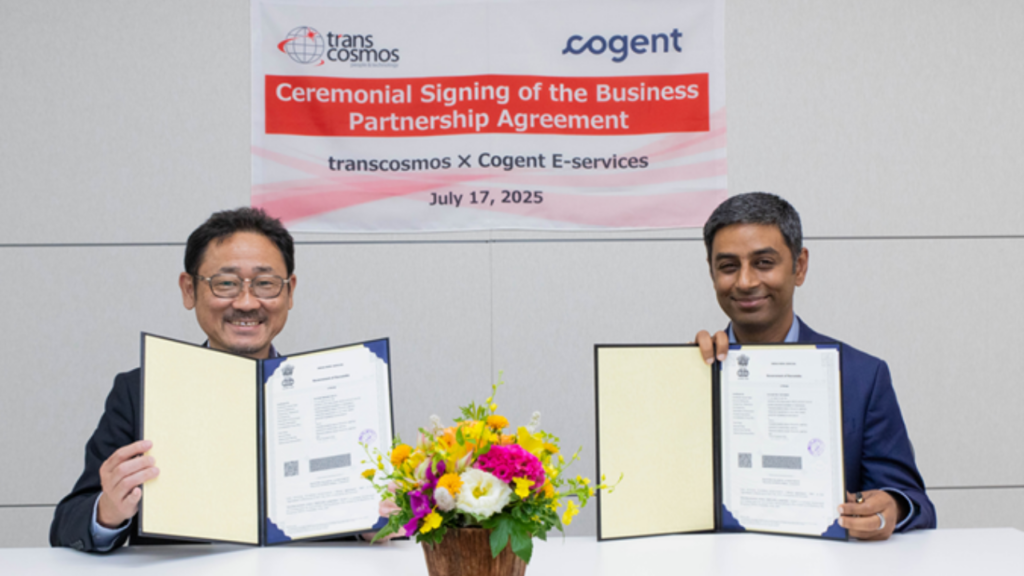
The transcosmos channel: On 17 July 2025 Cogent signed a strategic partnership agreement with Japan's transcosmos to offer contact centre services for both the India local market and international markets. The transcosmos release states that Cogent will be able to access the transcosmos global client network and offer services to those clients' Indian entities. This is the clearest external validation in the public record: a large multinational outsourcer chose Cogent as its India delivery partner rather than building its own domestic network. It also widens Cogent's addressable market, from Indian brands to the Indian operations of foreign multinationals, which tend to bring larger programmes and stricter compliance requirements.
Directory visibility: Outsource Accelerator's visibility labels for the firm, covering index rank, web authority, site traffic and review scores, are modest for a business of this claimed size. They are directory estimates rather than audited measures, and they sit oddly against a network of 24 centres. The contrast is a reminder that directory instrumentation and real operating scale are different things, and that a firm selling mostly to domestic enterprises through direct relationships may leave little trace in international outsourcing directories.
Delivery Infrastructure & Operations
Footprint: Cogent's network is domestic and broad. The about page names its cities as Noida, Gurugram, Meerut, Bareilly, Vadodara, Nashik, Thane, Navi Mumbai, Hyderabad, Anantapur, Mangaluru and Bengaluru, and the transcosmos release counts 24 centres across 12 Indian cities. The list runs from the national capital region through western and southern India, which supports both Hindi-belt and regional-language coverage. Where an offshore provider spreads seats across geographies to serve Western hours, Cogent concentrates seats inside one country to serve domestic volumes. The directory's prose refers to a presence across seven major cities, an older or partial count.
Beyond the metros: Several of the named cities, including Meerut, Bareilly, Anantapur and Mangaluru, sit outside India's main outsourcing hubs. Sites there give access to local-language talent pools away from the competition for staff in Noida, Gurugram or Bengaluru, which supports the vernacular pitch and spreads operational risk across regions.
Language coverage: The contact centre page says the firm can serve customers in more than 10 languages, including English, Hindi and regional languages, and the homepage repeats the same range. Outsource Accelerator's overview uses a different figure, stating that Cogent delivers customer experience solutions in 14 languages in the Indian subcontinent, while the same directory page elsewhere says 10 languages. Buyers should contract against the firm's own stated range and test specific languages during selection.
Operating hours: The homepage says the firm serves its clients round the clock to adapt to evolving customer requirements. Beyond city names and the centre count, no seat counts, shift structures, site-level addresses or business-continuity arrangements were found in the public record, so capacity cannot be verified from documents alone.
Compliance evidence: No firm-level certification, security attestation or audit statement was found on the pages reviewed. The closest public evidence is biographical: the Chief Operating Officer is described as a certified Six Sigma Black Belt and a lead auditor for ISO systems, with deployment experience of COPC and statistical process control techniques. That speaks to internal quality practice, not to a certificate. For banking and e-commerce work, the two verticals the firm names, buyers should expect to request information-security certification, data-residency and business-continuity evidence during diligence.
Directory footprint conflict: The directory panel lists several delivery countries for a firm whose own pages describe operations only in India. No readable source shows a Cogent centre outside India, and all 12 named cities are Indian, so the multi-country field reads as a record error rather than as an offshore footprint.
Hiring signals: The platform currently records 1 open job posting, a Sales Executive role in Hyderabad posted in October 2026, and rates the firm's hiring velocity as Minimal. For a workforce of this size, public job-board activity of that level says little about frontline recruitment, which in Indian domestic CX runs largely through channels the platform does not track.
Ownership, Financials & Scale
Ownership: The platform records Cogent as Private, and nothing in the reviewed sources names an outside shareholder or a parent group. The corporate form is more specific than that label captures. The company trades as Cogent E-Services Limited, and the corporate identity number in its website footer marks it as a public limited company registered in Delhi in 2004. Promoter ownership by the founding team is the working assumption for buyers, but it should be confirmed against the latest annual return.
The offer process: In February 2022 Cogent filed draft papers with the Securities and Exchange Board of India for an initial public offering combining a fresh issue of equity shares with an offer for sale by its promoters. In May 2022 it received the regulator's go-ahead to float the issue, and the plans also allowed for a pre-offer private placement of equity shares. Trendlyne still carries an offer page with the company's incorporation details, but no listing has followed, and the platform continues to record the company as private. The promoter sell-down in the draft papers shows the founders were prepared to dilute; whether that intent remains is an open diligence question.
Governance after the filing: The investors page publishes annual returns, a charter document, a CSR policy, a vigil mechanism or whistle-blower policy, the composition of the board and its committees, and the appointment terms of an independent director. These are the disclosures of a company that prepared for a listing and kept the structure in place afterwards. For a buyer, they give a documented governance baseline that most privately held CX agencies of similar size cannot offer.
Revenue: No company-published revenue figure for a recent period was found in readable form. A completed listing would have made audited financial disclosure routine; without it, outsiders have no current audited view of revenue, margins or growth, and buyers will need to request the accounts directly.
The scale contradiction: The firm's about page says more than 20,000 employees; the transcosmos release says more than 16,000 contact centre members; the directory's prose says a 10,000+ workforce; and earlier platform records put the workforce at 11,000. The directory's structured panel lists an employee band far below all of these. The first four figures are broadly coherent for a growing domestic operator measured at different dates and on different definitions, employees in one case and contact centre members in another. The panel band is the outlier: it contradicts the same page's prose, an independent partner statement and the firm's own pages, and it is the figure that would most mislead a buyer sizing the firm from the directory alone.
What the scale implies: A workforce of this size serving Indian brands in Indian languages points to domestic contract pricing rather than export-priced work. The firm's route to higher-value revenue therefore runs through the transcosmos channel and the international clients it opens, and through the e-commerce and consultancy lines that sit above seat-based voice.
People, Leadership & Culture
Managing Director: Co-founder Abhinav Singh leads the company as Managing Director. His about-page biography pairs a practical grasp of marketing strategy with knowledge of the financial domain. He is also the firm's external face: he represented Cogent at the transcosmos signing and, in the partner's release, cited more than 21 years of operating experience in Indian markets. A founder still in the top role after two decades gives long-standing clients continuity, and it concentrates succession risk in one person.
Chief Executive Officer: Co-founder Gaurav Abrol is Chief Executive Officer. The about page says he leads a team of more than 200 senior and middle-level managerial staff. A management layer of that size is what a multi-site domestic operation needs, and it means delivery quality depends on a broad middle-management bench rather than on a handful of named leaders. Buyers should meet the site-level managers who would run their account, not only the founders.
Corporate affairs: Co-founder Pranjal Kumar is Chief of Corporate Affairs, described on the about page as integral to forming the company's business strategies and assisting in their timely execution. With three founders sharing the top roles, strategy, operations oversight and external relationships are split across a stable trio rather than resting with a single owner.
Operations and a tenure conflict: Nitin Sahni is Chief Operating Officer. He worked with IBM Daksh and Tata Business Support Services before joining Cogent, has been associated with the company since 9 July 2014, and was appointed Chief Operating Officer on 13 January 2022. Outsource Accelerator's directory dates his tenure as COO from 2017. The firm's own page is the more granular source, distinguishing joining the company from taking the operating role, so the directory date should be read as a stale field. His background in two large Indian BPO operators brings process discipline that a founder-built firm needs as it scales.
Finance and compliance: The leadership page names Jaspreet Singh Arora as Chief Financial Officer and Niharika Agarwal as Company Secretary and Compliance Officer. She was appointed Company Secretary with effect from 17 November 2021 and Compliance Officer from 13 January 2022, the same date as the COO appointment. Dated appointments of this kind, clustered around the offer filing, are the governance build-out a company assembles ahead of a listing, and they remain in place.
Workforce disclosure: No attrition, engagement, training or pay data was found on the pages reviewed, so workforce stability cannot be assessed from documents. The long tenure of the founding bench and a COO who has been with the firm since 2014 are the only public stability signals. For a business whose quality rests on a large middle-management layer, attrition data at team-leader and manager level is the most useful single request a buyer can make.
Technology & Innovation
Stated stack: Cogent frames its technology as applied rather than proprietary: automation, analytics and AI/ML-based solutions are the named building blocks of its CX design. Outsource Accelerator's directory describes the firm as using technology to improve client-customer online engagement, and the platform lists AI & Automation Services among its service lines. The emphasis is on configuring tools inside client programmes rather than selling a branded platform.
Smart IVR: The most developed technology story is the smart IVR, one of the six published case studies. The CXM page says the firm developed an intelligent voice response system with the dual aim of reducing call volumes and solving customer concerns more efficiently. Its components include an after-hours customer response system and a smart caller identification tool for immediate caller identification. The design aims at deflection and prioritisation rather than at replacing agents, which is the lower-risk half of automation in a voice business.
Hybrid chatbot: The conversational layer is deliberately hybrid. Cogent describes its AI-based chatbot as able to handle customer interactions automatically while handing contacts to a live customer service associate in more complex situations. That is a realistic design for Indian domestic volumes, where language variety and policy complexity limit full automation. It also positions AI as augmentation of the contact centre rather than as a cost-reduction platform that would shrink the firm's own labour base.
Integration work: The automotive location-mapping case shows integration into client workflows. Cogent used the geolocation interface in the caller's phone browser to obtain the vehicle's latitude and longitude, plotted the position on a third-party web mapping platform, and built a customer relationship tool for efficient ticket management. Assembling standard components this way is typical of mid-market CXM rather than a platform play, but it is the capability that separates an operator from a seat provider, and it is work that is hard for a client to move to another vendor.
Partnership as capability: The transcosmos agreement is the firm's clearest route to capability and reach beyond its own stack. Both sides describe it as an agreement to offer contact centre services for the India local market and international markets, rather than as licensed technology, and the signing ceremony on 17 July 2025 brought both leadership teams together. International programmes arriving through the partnership would also bring the client-side technology requirements of multinational buyers, which would push Cogent's tooling towards the standards those clients expect.
Technology gaps: No named contact centre platform, workforce management system, security tooling or AI vendor partnership was found on the pages reviewed. Buyers evaluating Cogent for regulated banking work should ask which telephony, CRM and analytics platforms run in production, and where client data is hosted.
Strategic Assessment
Strengths
- Founder-led continuity. The three co-founders hold the Managing Director, Chief Executive Officer and Chief of Corporate Affairs roles, and the COO has been with the firm since 2014. Long-standing clients deal with stable owner-operators rather than rotating management.
- Domestic language reach at scale. A network of 24 centres in 12 Indian cities with vernacular capability in more than 10 languages takes years to assemble. Offshore providers cannot easily match it for India-for-India work.
- A multinational channel. The transcosmos partnership opens the Indian entities of a global client network, a source of demand Cogent's domestic sales effort would not reach alone.
- Breadth beyond voice. E-commerce operations, returns management, digital marketing and CX consultancy spread the firm beyond contact-centre hours and into work that sits closer to a client's revenue.
- Governance infrastructure. A named CFO, a company secretary and compliance officer, published board-committee composition and governance policies give Cogent a disclosure baseline that most private CX agencies lack.
Risks and Vulnerabilities
- Directory record versus reality. The directory panel's small employee band and multi-country delivery count conflict with primary sources describing a workforce above 16,000 in India only. A buyer sizing the firm from the directory would misread its capacity.
- No verifiable client proof. No named client and no measured outcome appear in the readable record, so commercial claims cannot be tested before contracting.
- Compliance evidence missing from the public record. For the banking and e-commerce clients the firm targets, absent certification detail is the gap that most often slows procurement.
- Financial opacity. The offer process did not lead to a listing, so there are no continuing audited disclosures, and current revenue and profitability are unknown to outsiders.
- Domestic concentration. A network serving Indian volumes is exposed to domestic pricing pressure without the currency and geographic diversification of an export operator.
Opportunities
- Domestic digital demand. As Indian banks and e-commerce brands move more service into digital and vernacular channels, a multi-city network with regional-language coverage is placed to take that volume.
- International clients' Indian operations. Through transcosmos, the existing network can serve the Indian entities of global clients, which would turn domestic capacity into larger and better-documented programmes.
- Automation-led commercial models. The smart IVR and hybrid chatbot support deflection and self-service, which can move commercial terms from seats towards outcomes and raise the value of each interaction.
- Deeper e-commerce mandates. Catalogue, logistics, loyalty and returns work sits close to fulfilment and can expand an e-commerce account well beyond contact handling.
Outlook
The firm's own stated priorities are multilingual delivery, which it says provides operational excellence, and digital CX built on automation, analytics and AI/ML. The transcosmos partnership is the only forward commitment with a named counterparty, and it points to the Indian operations of international clients as the next stage of growth. The diligence priorities are a current, location-level headcount, client references, security certification evidence and audited accounts.