• 4,000 firms
  • Independent
  • Trusted
Save up to 70% on staff

Home » Glossary » Podcast Virtual Assistant

Podcast Virtual Assistant

Definition

Podcast virtual assistant

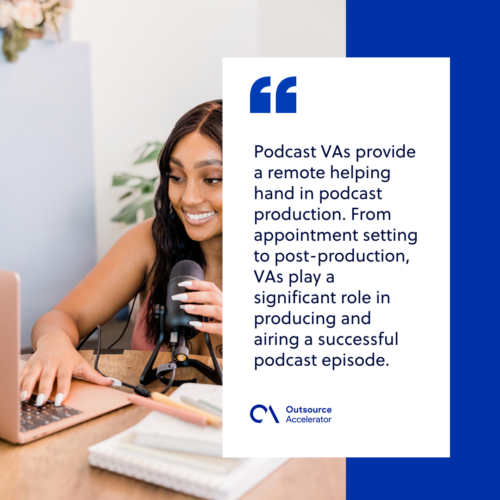
A podcast virtual assistant is a remote contractor who handles the editing, publishing, and promotion behind a podcast so the host can focus on interviews. Most work offshore on hourly rates or monthly retainer packages, at a fraction of studio production costs.

Podcast VAs typically sit in the Philippines, India, or Latin America. They’re one branch of a wider family of remote specialist roles hosts hire to run everything from calendars to CRM cleanup.

The scope splits into three buckets. Pre-production covers guest booking and episode research. Post-production covers audio cleanup, mixing, and transcription. Distribution covers uploads to Spotify or Apple Podcasts, show notes, and social clips.

Podcasting itself only launched in 2004, per Wikipedia, and Grand View Research puts the global market above $30 billion in 2024. The role scaled with the medium.

Key takeaways

  • Podcast VAs handle editing, notes, uploads, and promotion — every task except hosting itself.
  • Filipino rates start at $5 to $8 per hour on freelance boards and $8 to $15 through outsourcing firms.
  • Weekly shows typically free 8 to 12 host hours per episode by delegating post-production.
  • Common toolchains combine Descript, Riverside, Buzzsprout, and Notion or Trello.
  • Most hosts hire through outsourcing partners rather than freelance boards for workflow continuity.

How it works

A podcast VA runs the recurring production checklist so the host doesn’t have to. Typical scopes include guest booking, pre-interview research, audio editing, show note drafting, RSS uploads, transcription, and social promotion.

Some also manage sponsor outreach and analytics.

Seniority tiers matter. Entry-level VAs handle scheduling and simple audio edits. Senior producers own the whole workflow — pitching, editing, notes, promotion — and often manage a junior teammate for the volume tasks.

Most hosts move to this model after 6 to 10 episodes. That’s when the production tail of editing, notes, and scheduling starts eating into the time available for guest sourcing and audience growth.

The workflow usually runs on shared drives. Hosts drop raw recordings into Dropbox or Google Drive; the VA pulls files, edits in Descript, Auphonic, or Audacity, then uploads a finished master for approval. Turnaround runs 24 to 72 hours per episode.

Rates vary widely by region and sourcing channel. The table below summarises typical 2024 pricing.

Sourcing channelRegionHourly rate (2024)
Freelance boards (Upwork, Fiverr)Philippines$5 to $8
Outsourcing firmPhilippines$8 to $15
Freelance boardsEastern Europe$12 to $25
Boutique agencyUS or UK$25 to $60

Ranges compile industry postings and PayScale data on Filipino VA hourly rates, cross-checked against agency public rate cards over 2023 to 2024. Rates trend up sharply for hosts who need same-day turnaround or true multi-language editing capacity.

Hourly billing suits shows with variable output. Retainer packages of 10 to 20 hours per week work better for weekly programs where the volume is predictable and hosts want a fixed monthly figure.

Longer retainers, over three months, usually earn a 5 to 15 percent rate discount.

Examples

Podcast VAs power a wide slice of the top independent shows. The pattern is consistent: solo or small-team hosts offload the production tail to a remote specialist, then reinvest saved hours into audience growth.

Solo business podcasters. Marketing coaches, financial planners, and career strategists running weekly shows are the biggest hiring bucket. A VA takes two hours of raw audio and returns a mixed 45-minute episode plus a LinkedIn snippet pack.

B2B brand podcasts. HubSpot, Salesforce, and Drift have all run branded shows staffed by internal producers plus outsourced editors handling audio polish, transcription, and clip creation. That layer keeps strategy in-house while offloading production.

Nonprofit and university podcasts. Museums, alumni offices, and mission-driven groups often lack in-house audio talent. A Philippines-based VA fills the gap for under $1,000 a month, letting the organisation ship a monthly show without hiring a producer.

Media agencies. Full-service podcast agencies like Lower Street and Fame layer VAs beneath senior producers, using them for guest scheduling, transcript cleanup, and asset packaging while producers focus on client strategy.

Related terms

Podcast VA sits inside a broader family of remote support roles. The terms below cover adjacent specialisms hosts often need alongside their podcast producer, from content and admin to client-facing work. Most shows hire a mix of two or three roles.

  • Virtual Assistant: the parent role covering all remote administrative and specialist support hires.
  • Business Process Outsourcing: the broader delivery model behind most agency-hired podcast VAs.
  • Freelancer: the direct-hire alternative to going through an outsourcing firm.
  • Digital Nomad: a lifestyle category many freelance VAs adopt while working with international clients.
  • Offshoring: the geographic sourcing pattern placing most podcast VAs in the Philippines or Latin America.
  • Back Office Outsourcing: the adjacent category covering admin work like scheduling, invoicing, and CRM cleanup.

FAQ

What does a podcast virtual assistant do?

A podcast VA handles the recurring production tasks around a show: booking guests, editing audio, drafting show notes, uploading to hosting platforms, and promoting each episode on social media. Some also manage sponsor outreach and analytics.

How much does a podcast virtual assistant cost?

Filipino podcast VAs charge $5 to $8 per hour on freelance boards and $8 to $15 per hour through outsourcing firms. American and British specialists start closer to $25 per hour. Monthly retainers of $500 to $1,500 are common for weekly shows.

Do podcast VAs work remotely?

Yes. The role is virtual by definition — most VAs work from home offices, and a growing share operate as digital nomads travelling between cities. Clients care about output rather than location.

What skills should a podcast VA have?

Look for audio editing chops in Descript, Audacity, or Adobe Audition, plus strong written English for show notes and transcript cleanup.

The best ones sit closer to generalist utility players than narrow specialists. Reliability and calendar discipline matter more than raw technical polish.

Where do you hire a podcast virtual assistant?

Hosts hire through freelance boards like Upwork and Fiverr, specialist agencies like Podcastle and Podsworth Media, or outsourcing firms that recruit and manage the VA on your behalf. Outsourcing usually wins on continuity for weekly shows.

Can one podcast VA cover the whole workflow?

For solo shows publishing weekly, one senior VA usually covers booking, editing, notes, and social promotion.

Larger networks split the workload across separate audio, admin, and marketing specialists to keep quality consistent across dozens of shows, while solo generalists still dominate by volume.

Ready to hire a podcast production partner — browse vetted providers on the OA outsourcing directory.

Outsourcing FAQ

How do I start working as a virtual assistant?

When you feel like you have the right skills and qualifications for the job, you may start working as a virtual assistant. There are different types of virtual assistants, like podcast VAs, social media VA, marketing VA, legal VA, and more. The first step is to find your niche, so you can market yourself better for potential clients.

Aspiring VAs can create accounts on Upwork or Freelancer to find jobs, but some small to medium-sized companies prefer hiring through business process outsourcing companies to ensure workforce quality and stability. If a company is hiring more than one VA, it would be more practical to seek the help of an outsourcing company.

Do virtual assistants work from home?

Virtual assistants are “virtual” because they don’t work physically in an office. The jobs assigned to them can be done remotely, anywhere they want. They take care of their own internet connection, equipment, and other things needed for their work. 

While most virtual assistants have established their own home offices to have a conducive working environment, some choose the life of a digital nomad. Clients usually do not care wherever you choose to work, as long as the tasks are done efficiently and in a timely manner.

How much do Filipino virtual assistants make?

A virtual assistant’s pay depends on their expertise and years of experience. However, according to Payscale, an average VA makes a minimum hourly pay of $4. 

Where you find your podcast virtual assistant also plays a part in determining their salary per month. Freelance VAs hired through popular job platforms like Upwork and Fiverr start at $5 per hour, while those hired through outsourcing companies’ rates start at $8 per hour. With virtual assistants, you can save a lot of money on labor costs, but not to the point of consuming cheap labor.

How do I become a successful virtual assistant?

Effective communication is the key to becoming a successful virtual assistant. Excellent communication skills, flexibility, and friendly attitude (for customer service) can go a long way. In addition, a successful Amazon VA needs to be updated with the latest sales, marketing, and social media trends in order to attract and retain customers.

Further, VAs in general need to have the following skills and characteristics: 

– Time management skills

– Organizational skills

– Problem-solving skills

– Adaptability and versatility

Jack-of-all-trades

– Dependable and consistent

– Trustworthy and proactivity

– Efficiency and professionalism

Companies you might be interested in

Get Inside Outsourcing

An insider's view on why remote and offshore staffing is radically changing the future of work.

Order now

Start your
journey today

  • Independent
  • Secure
  • Transparent

About OA

Outsource Accelerator is the trusted source of independent information, advisory and expert implementation of Business Process Outsourcing (BPO).

The #1 outsourcing authority

Outsource Accelerator offers the world’s leading aggregator marketplace for outsourcing. It specifically provides the conduit between world-leading outsourcing suppliers and the businesses – clients – across the globe.

The Outsource Accelerator website has over 5,000 articles, 450+ podcast episodes, and a comprehensive directory with 4,700+ BPO companies… all designed to make it easier for clients to learn about – and engage with – outsourcing.

About Derek Gallimore

Derek Gallimore has been in business for 20 years, outsourcing for over eight years, and has been living in Manila (the heart of global outsourcing) since 2014. Derek is the founder and CEO of Outsource Accelerator, and is regarded as a leading expert on all things outsourcing.

“Excellent service for outsourcing advice and expertise for my business.”

Learn more
Banner Image
Get 3 Free Quotes Verified Outsourcing Suppliers
4,000 firms.Just 2 minutes to complete.
SAVE UP TO
70% ON STAFF COSTS
Learn more

Connect with over 4,000 outsourcing services providers.

Banner Image

Transform your business with skilled offshore talent.

  • 4,000 firms
  • Simple
  • Transparent
Banner Image