• 4,000 firms
  • Independent
  • Trusted
Save up to 70% on staff

Home » Glossary » Rostered staff factor

Rostered staff factor

Definition

Rostered staff factor

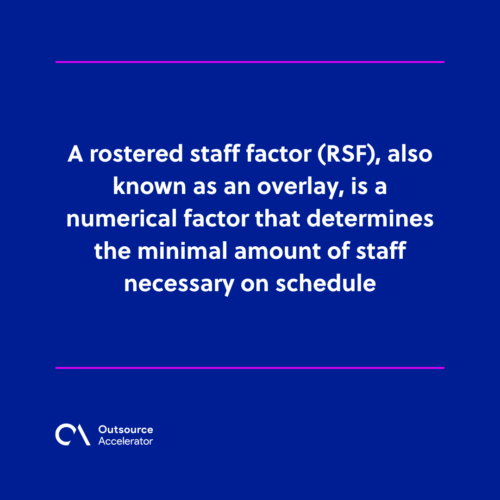
Rostered staff factor (RSF) is the multiplier that tells a contact center how many agents to roster above its base requirement, so that breaks, leave, training and absence never pull answered volume below the service level you have promised the client.

Also called overlay, RSF folds shrinkage into headcount planning. Divide total staff required by base staff and you have it. If a queue needs 100 productive agents but 25% go missing each shift, you roster 133. That is an RSF of 1.33.

The metric matters because a base-only schedule almost always understaffs the phones. Every missed forecast turns into an abandoned call, a broken service agreement, or a coaching hour cut short.

Use the outsourcing calculator to size offshore savings before shrinkage quietly eats the assumptions underneath them.

Key takeaways

  • RSF equals total scheduled headcount divided by the base staff your forecast requires.
  • Typical overlay multipliers run from 1.15 to 1.55, depending on the shrinkage profile.
  • Leave, training, meetings and off-phone admin are the four biggest shrinkage drivers.
  • Skimping on RSF collapses service levels first, then agent retention.
  • Email and chat queues carry a lower RSF than voice, usually 1.10 to 1.20.

How it works

RSF works by turning shrinkage — every paid hour an agent spends away from the queue — into an over-hire factor. Take the base agents your forecast model produces, multiply by RSF, and you get the roster count your schedule actually needs.

The formula is short: RSF = (base staff + shrinkage allowance) ÷ base staff. A worked example: if demand needs 80 base agents and shrinkage runs at 25%, the roster requirement is 80 ÷ 0.75 = 107 seats. That gives an RSF of 1.34.

One caution. RSF is a divisor, not an add-on. Adding 25% to 80 agents gives 100 seats, which still leaves the queue short. Dividing 80 by 0.75 gives 107, and that seven-seat gap is where most understaffed rosters begin.

Most contact centers split shrinkage into two buckets. The scheduled bucket covers breaks, meetings, coaching and ongoing training. The unscheduled bucket covers sick days, tardiness and off-phone work.

Call Centre Helper’s guide to calculating contact centre shrinkage works through the same two-bucket split, and warns that planners who count only rostered breaks understate the real number badly.

The 2024 ICMI Contact Center Operations study pegs typical shrinkage between 30% and 35% across business process outsourcing (BPO) programs. That range pushes RSF into the 1.43 to 1.54 band.

Shrinkage rateRSF multiplierBase 100 agents → roster
15%1.18118
25%1.33133
30%1.43143
35%1.54154
40%1.67167

Source: ICMI 2024 industry benchmarks and standard Erlang C practice.

Workforce managers rebuild RSF quarterly. Absenteeism drifts with flu season, new-hire cohorts swell the training bucket, and any move in average handle time (AHT) changes how much slack the base count already carries.

The ultimate guide to outsourcing explains where these headcount buffers sit inside vendor pricing, and how easily they vanish from a per-seat quote that looks cheap on the first page.

Examples

In practice, RSF adds 15% to 45% onto the published schedule. Philippine outsourcing sites, United States inbound sales teams and Australian utility helplines all price that overlay into operational headcount from the very first staffing run.

A Metro Manila customer service center running 200 base agents at 32% shrinkage rosters 294 seats — an RSF of 1.47. Those extra 94 heads fund two-week new-hire nesting, monthly quality calibration, and typhoon-day absence spikes.

The top 40 BPO companies in the Philippines publish RSF assumptions inside client statements of work. In 2024, TaskUs and Concentrix both flagged shrinkage climbing above 30% across Southeast Asian sites, citing tighter training regimes and hybrid schedules.

Their overlay assumptions rose in step, a trend also tracked by OA News on offshore outsourcing demand.

Utility contact centers in Australia, Origin Energy and AGL among them, carry higher RSFs on Mondays and post-bill-run days, sometimes touching 1.60. Complaint queues spike at the same hour that adherence loosens.

Deloitte’s 2024 Global Outsourcing Survey found the same Monday peak across financial services helplines. Philippines-based utility support partners often layer regional adherence data into their local RSF models.

A 50-seat legal answering line at a United States firm running lean at 18% shrinkage schedules 61 agents — an RSF of 1.22. Small teams hold the multiplier low because unscheduled absence stays visible and gets covered peer to peer.

OA’s Inside Outsourcing magazine profiles how boutique providers price that discipline into per-seat rates, and the Source directory lists partners that publish their RSF benchmarks openly.

Pandemic-era volatility, chronicled in the coronavirus and BPO outsourcing podcast, taught most operators to widen their RSF band by two to four points and to leave it there.

Related terms

RSF sits inside a small cluster of workforce planning terms. Each one either feeds the multiplier, consumes its output, or measures whether the roster held on the day. The boundary is simple: they describe staffing arithmetic, not conversation quality.

  • Shrinkage: total paid hours agents spend off the queue, and the largest single input to RSF.
  • Erlang C: the queuing formula that outputs base agent count before any overlay is applied.
  • Service Level: the answer-in-X-seconds target that drives the base staffing number.
  • Full-Time Employee (FTE): the headcount unit RSF translates rostered hours into.
  • Schedule Adherence: the discipline governing how much shrinkage lands in the unscheduled bucket.
  • Workforce Management: the planning function that owns forecasting, scheduling and RSF review.

FAQ

These are the questions workforce planners ask most about rostered staff factor, in the order they usually come up: what good looks like, how to calculate it, how it differs from shrinkage, how often to revisit it, and where it applies.

What is a good rostered staff factor?

For most inbound contact centers, an RSF between 1.30 and 1.45 is the working band. Below 1.20 usually signals under-counted shrinkage. Above 1.55 hints at chronic absenteeism, over-scheduled training, or a bloated handle time.

How do you calculate rostered staff factor?

Divide total scheduled headcount by the base staff your queuing model requires. If the model calls for 100 agents and you must roster 135 to cover shrinkage, your RSF is 1.35.

Is RSF the same as shrinkage?

No, they measure different things. Shrinkage is the share of paid time lost to off-queue activity, while RSF is the multiplier that turns that loss into extra bodies on the schedule.

How often should RSF be reviewed?

Quarterly at minimum, and again after any major operational change: a new campaign, a shift redesign, peak season, or a large hiring wave. Some workforce teams recut it monthly through onboarding-heavy quarters.

Does RSF apply to back-office and email queues?

Yes, but with a smaller multiplier, because asynchronous queues absorb absence more easily than voice and typically run 1.10 to 1.20 rather than 1.30 and above.

Explore OA’s outsourcing hubs to compare BPO partners whose workforce teams design RSF into every statement of work.

Companies you might be interested in

Get Inside Outsourcing

An insider's view on why remote and offshore staffing is radically changing the future of work.

Order now

Start your
journey today

  • Independent
  • Secure
  • Transparent

About OA

Outsource Accelerator is the trusted source of independent information, advisory and expert implementation of Business Process Outsourcing (BPO).

The #1 outsourcing authority

Outsource Accelerator offers the world’s leading aggregator marketplace for outsourcing. It specifically provides the conduit between world-leading outsourcing suppliers and the businesses – clients – across the globe.

The Outsource Accelerator website has over 5,000 articles, 450+ podcast episodes, and a comprehensive directory with 4,700+ BPO companies… all designed to make it easier for clients to learn about – and engage with – outsourcing.

About Derek Gallimore

Derek Gallimore has been in business for 20 years, outsourcing for over eight years, and has been living in Manila (the heart of global outsourcing) since 2014. Derek is the founder and CEO of Outsource Accelerator, and is regarded as a leading expert on all things outsourcing.

“Excellent service for outsourcing advice and expertise for my business.”

Learn more
Banner Image
Get 3 Free Quotes Verified Outsourcing Suppliers
4,000 firms.Just 2 minutes to complete.
SAVE UP TO
70% ON STAFF COSTS
Learn more

Connect with over 4,000 outsourcing services providers.

Banner Image

Transform your business with skilled offshore talent.

  • 4,000 firms
  • Simple
  • Transparent
Banner Image