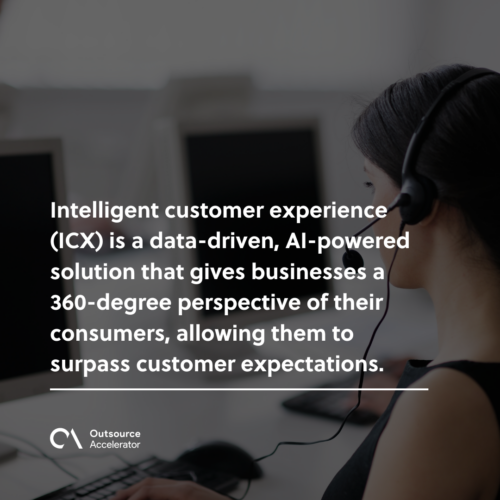
Intelligent customer experience (ICX)
Definition
Intelligent customer experience (ICX)

Intelligent customer experience (ICX) is AI-powered customer engagement — reading unified data and threading every channel so replies stay in context. ICX turns fragmented service into one continuous conversation, letting brands anticipate needs and shorten resolution across live chat, voice, and email.
The concept moved from theory to standard practice through 2023 and 2024 as generative AI copilots, unified customer data platforms, and voice bots matured together.
Qualtrics research on shifting customer expectations shows the modern buyer now expects brands to remember them across every channel and every prior conversation.
BPO providers in the Philippines and India have rebuilt agent desktops around ICX — pairing human empathy with machine memory.
Global brands now offshore the whole stack rather than just the seats, so the AI model, the analytics layer, and the trained agents ship together.
The playbook varies by sector: retail leans on chat and product data, banks on secure voice and fraud signals, healthcare on booking and follow-up. Regulated industries add compliance guardrails so AI outputs stay inside legal scope.
Done well, ICX cuts average handle time, lifts first-contact resolution, and moves the CSAT needle by keeping context intact through every hand-off. Done poorly, it becomes an expensive chatbot — with a nicer name and rougher metrics than the flow it replaced.
Key takeaways
- ICX blends AI, unified customer data, and multiple channels into one context-aware exchange.
- Five characteristics (conversational, omnichannel, contextual, automated, and predictive) separate ICX from ordinary customer experience (CX).
- Deployments pair AI tools with trained agents from a business process outsourcing (BPO) partner.
- Rollouts follow a five-step arc: vision, content audit, process coordination, technology upgrade, and organization change.
- Vendors like Salesforce, Zendesk, and NICE ship ICX platforms; BPO partners run them at scale.
How it works
An ICX stack listens on every channel the customer uses, feeds each event into a unified profile, and lets an AI layer pick the next best action. Human agents step in when the model flags ambiguity, empathy, or high-value revenue moments.
The result is a service layer that scales like software but reads like a helpful human.
Five characteristics define the model, as Simple A first framed the pattern:
| Trait | What it means | Example enabler |
|---|---|---|
| Conversational | Two-way natural-language dialogue, voice or text | Generative AI copilots |
| Omnichannel | Continuous thread across chat, email, voice, social | Customer data platform |
| Contextual | Every reply informed by past interactions and profile | Real-time customer 360 view |
| Automated | Routine queries resolved without human handoff | Rule-based and AI chatbots |
| Predictive | Anticipates next need from behavior signals | Machine-learning models |
Rollouts typically follow five steps:
- Step 1: set a vision for the target customer experience.
- Step 2: audit the content and data feeding every channel.
- Step 3: coordinate the content process across product, service, and marketing.
- Step 4: upgrade the technology — usually a CRM, chatbot, and analytics layer.
- Step 5: restructure the team so agents, data scientists, and CX designers sit close together.
Examples
Bank of America’s Erica. The bank’s AI assistant surpassed 2 billion client interactions by early 2024, per company disclosures.
Erica handles balance queries, spend insights, and fraud alerts across the mobile app. It routes complex conversations to human agents when the model detects frustration or product complexity.
Sephora’s Virtual Artist and Beauty Insider. Since 2023 the retailer has combined an AI try-on tool with a unified loyalty profile, so every online recommendation and every store visit builds on the same customer history.
Store associates in 2024 rollouts see the same profile the app does.
KLM Royal Dutch Airlines on WhatsApp. KLM has fielded booking confirmations, boarding-pass delivery, and disruption alerts on WhatsApp with a mix of automation and human agents, an early example of channel-native ICX.
Passengers stay inside the app they already open dozens of times a day.
Domino’s voice ordering. The pizza chain’s AnyWare platform lets customers reorder by voice, text, smartwatch, or car dashboard, all tied to a single account history.
The company treats voice and mobile channels as one continuous funnel rather than isolated apps.
Related terms
- Customer experience (CX): the broader parent discipline ICX modernizes with AI.
- Omnichannel: the channel architecture ICX depends on for continuity.
- Chatbot: the most visible automated layer inside an ICX stack.
- Customer relationship management (CRM): the system of record ICX reads from and writes to.
- Artificial intelligence (AI): the model layer that makes ICX predictive.
- Business process outsourcing (BPO): the delivery model many brands use to staff ICX programs.
FAQ
What is intelligent customer experience (ICX)?
ICX is a customer service model in which AI, real-time customer data, and connected channels combine to deliver context-aware interactions across the full journey. Every touchpoint reads the same profile.
How is ICX different from CX?
Traditional CX measures how customers feel across every brand touch. ICX layers AI, machine learning, and unified data on top, so the experience adapts in real time rather than following static scripts. The step change is prediction and personalization at machine speed.
Which industries benefit most from ICX?
Retail, banking, telecoms, travel, and healthcare see the largest lift because they run high volumes of repetitive queries alongside high-value exceptions. According to Wikipedia’s overview of customer experience, the field has expanded into every service sector where a brand and a buyer maintain an ongoing relationship.
Do you need AI to deliver ICX?
Yes. The “intelligent” element assumes machine learning or generative AI. Without it, you have well-run omnichannel CX, not ICX. Rules-only automation lacks the prediction layer that lets systems anticipate the next question before the customer asks it.
Can a BPO run ICX for a smaller brand?
Yes. Philippine and Indian BPOs now ship ICX-ready pods bundling software, analytics, and agents, cutting the setup cost that used to lock smaller brands out. Providers charge on a per-seat or outcome basis, so a 10-person retailer can access the same tools an enterprise brand uses.
How do you measure ICX success?
Common metrics are CSAT, NPS, first-contact resolution, average handle time, and containment rate on automated channels. Best-in-class programs also track a composite score that weights speed against sentiment and against revenue retained.


Independent